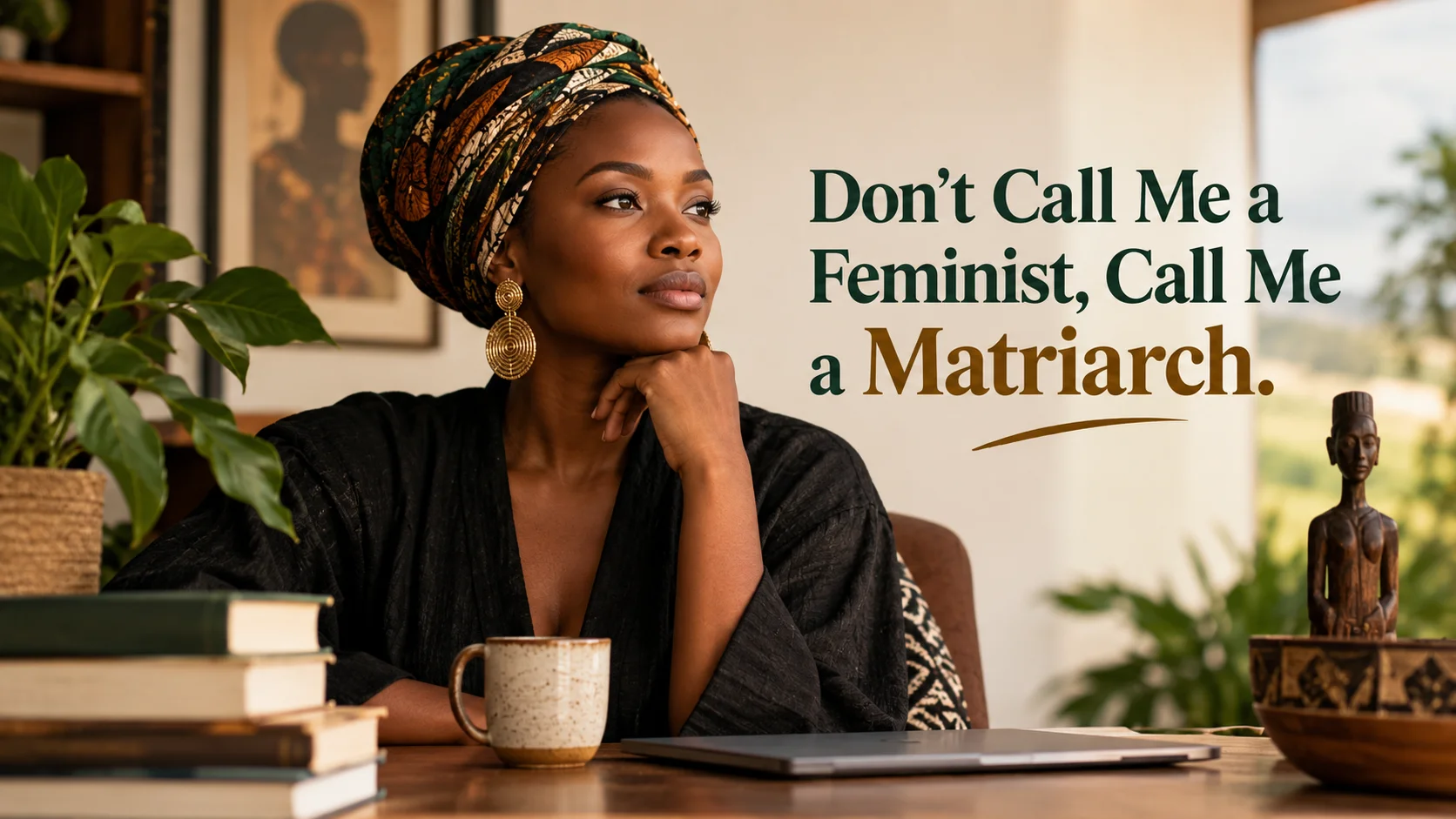
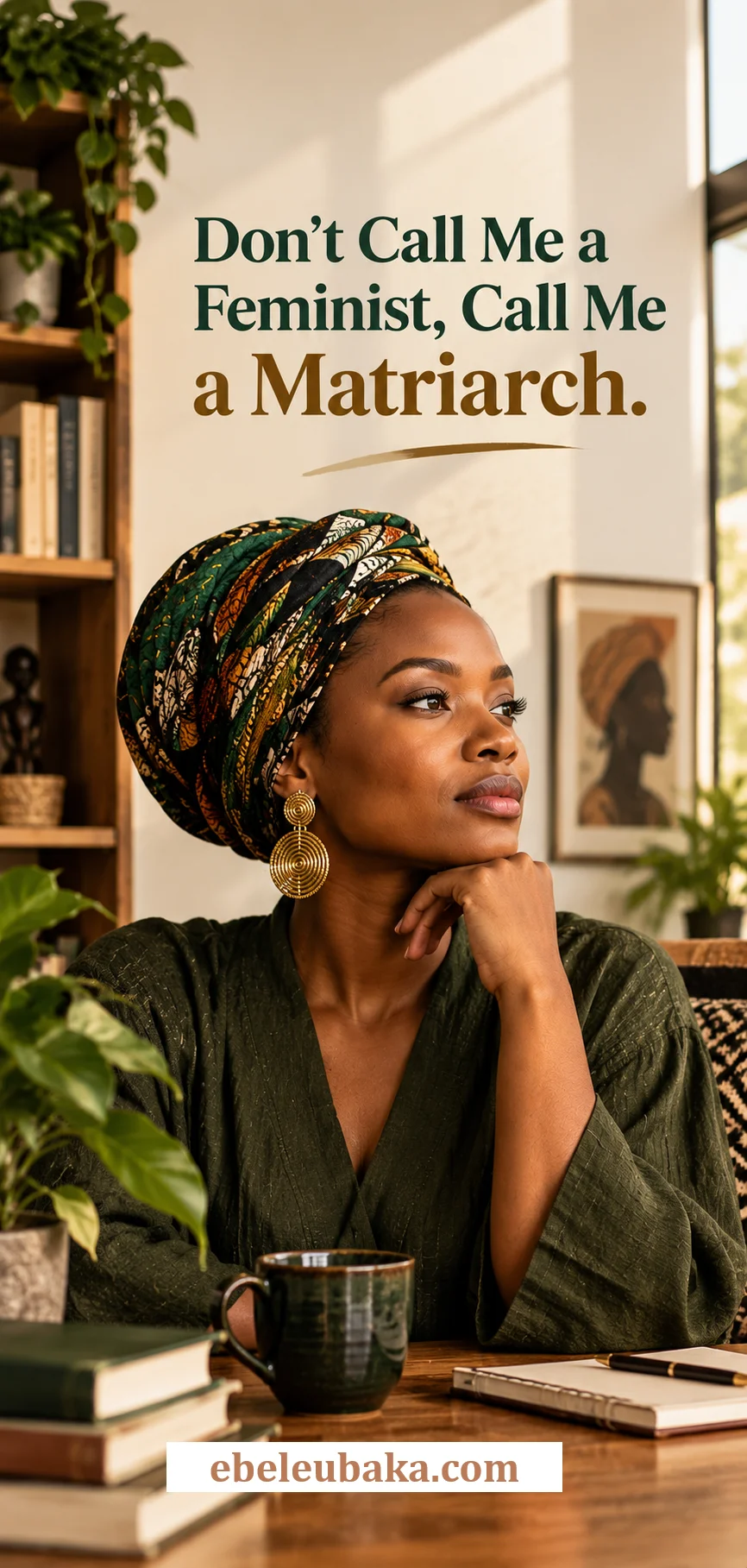
Don’t Call Me a Feminist, Call Me a Matriarch.
I don’t like the word “feminist”, not because of what it has been painted to be, but because it is too limiting for my ambiguous mind. I find labels uncomfortable in general, but especially labels that seem to require me to explain myself before I have even had the chance to exist as I am.
There is something about feminism as a word that, when I am called one by guys I know in real life, makes me feel like I am being invited into an argument I didn’t ask to have. I don’t want to spend my life defending what should simply be the basic right of a woman to be fully human.
My mother more than once asked me, “Gi na nwoke aga ebi nwu kwa?”
I couldn’t voice my answer to the question at the time. For an African mother, that’s a rhetorical question. Giving an answer, even a sarcastic one (which I was tempted to give) will earn me some pummelling time.
What I felt she was really asking, of course, was whether I intended to go through life behaving like a man, making decisions like a man, defending my stance like a man and so unwilling to bend myself into the shape expected of a “good girl”. It was not really about dwelling in marriage with a man. It was about my behaviour. There was a certain kind of womanhood I was expected to grow into, and to her, I seemed determined to keep stepping outside its boundaries.
I quickly realised I wasn’t like the norm. Many were courteous, obedient, demure and all things that made a mother meeting a young girl for the first time desire her to be married to her son.
I wasn’t. I mean, I tried.
The more I tried to play the compliant child, the more my spirit rebelled. I wanted friends, so I tried adapting, being submissive, being accommodating. I learned, as many girls do, that sometimes belonging seems to require a lot more of self-erasure. You become easier to like when you are always agreeable, you don’t challenge people, easier to keep around when you don’t have too many opinions, and easier to approve of when you don’t make anybody uncomfortable.
But there was always something in me that refused to settle into that arrangement completely. I could behave myself for a while, but I could never successfully become somebody else. The more I tried to suppress the parts of myself that were considered inconvenient, the louder those parts became. It wasn’t rebellion for the sake of rebellion. I simply could not understand why being a good woman had to involve handing another human being the reins of my life.
Ask the people I went to secondary school with. I wasn’t particularly liked because I detested being controlled. Ironically, I had been trained to control others, but I quickly realised that I couldn’t give what I didn’t like receiving. If I hated having someone else dictate how I should think, behave or live, why would I turn around and do the same thing to others?
And this is where I think my problem with the word “feminist” begins.
I understand why we need feminism. I understand the history behind it, the battles women have had to fight, and the very real inequalities that still exist. I am not interested in pretending those things don’t matter. What I struggle with is the feeling that even our liberation can sometimes come with another prescribed identity, another box we are expected to fit into, another definition of what a liberated woman should look and sound like. Sometimes, even the language of liberation begins to tell women what they ought to become.
Maybe I don’t want another box.
Maybe I don’t want to spend my life proving that I can do everything a man can do. I don’t wake up every morning thinking about men and wondering whether I am keeping up with them. They don’t pay such attention to women.
I am far more interested in becoming fully myself than in measuring myself against somebody else’s existence. My ambition isn’t to become a woman who can compete with men at being men. It is to become a woman who is completely at home in herself, with all her wants, needs, contradictions and desires.
Read Also: How I combat depression when the going gets tough
Some women who claim “feminism” have also created their own idea of what a liberated woman should look like. There is still a script: what she should believe, how she should speak, how she should relate to men, what kind of relationships she should want, and sometimes even what kind of woman she is allowed to be. I find that just as limiting as what is in existence. If liberation means I have to exchange one prescribed identity for another, then I am not sure how liberated I am.
This, to me, is where the word “matriarch” begins to make more sense.
I don’t mean a woman who rules over everyone around her. I don’t mean female domination. That would only be recreating the same sickness we claim to be fighting, except with a woman sitting in the chair.
When I say matriarch, I mean a woman who has become deeply rooted in herself. A woman who knows where she comes from, understands what she carries, and has enough self-awareness to decide what she will pass on and what ends with her.
A matriarch is not the loudest woman in the room. She doesn’t have to dominate conversations or intimidate everybody around her. She can listen without submitting, love without losing herself, and compromise without surrender.
I want to be a woman who can need somebody without becoming dependent on their approval for my sense of worth. I want to love a man without making him the authority on who I am. I want intimacy and partnership, not supervision, I don’t need you checkmenting me.
I don’t want a man I can control, either. I’m not looking for a puppet with a penis.
I want a man who doesn’t need nor desire to control me. I don’t want to pretend to be less intelligent. I don’t want to hide my competence so that he can feel like he is the head for which a headgear was made.
I don’t want to spend my life carefully managing a man’s ego so that the relationship can remain peaceful. You test me once with such manipulation and we are done.
My mother would quickly ask us to get her head-tie whenever we had a male visitor. For God’s sake, the visitor is the one to conduct themselves accordingly, since they are the ones invading the privacy of our home.
We are expected to anticipate moods, soften truths, remember everyone’s needs, serve several lunch meals according to one’s choice, maintain relationships, keep the peace and somehow make all of this look effortless. Then, when we finally become exhausted, we are praised for being strong.
I don’t want to be praised for surviving a life I was never supposed to have to endure.
I want women to be free, to be whole. If I don’t like something that is unique to me, I say it. Don’t compare me to the next woman, describing how she accommodates that thing I didn’t like.
I want us to be able to be soft without being considered weak, assertive without being considered difficult, ambitious without being considered selfish, sexually feral without being considered immoral, and independent without everybody assuming we have a problem with men.
Women love honestly, they care deeply, they cry, they forgive, they laugh loudly, they make mistakes and they get their hearts broken. Their strength isn’t that nothing can touch them. Their strength is that what touches them does not get to permanently decide who they become.
Maybe that is the kind of woman I have always been trying to become.
Not the perfect woman. Not the obedient woman. Not the woman who makes everybody comfortable. Not even the woman who is always right. H*ll, I’m wrong 99.99% of the time.
I’m also not interested in raising daughters who spend their entire childhood and pre-adult “preparing to be chosen” or in being “the one”.
I want girls to know how to choose. You have every right, girl.
I want them to know how to choose friends, how to choose work, how to choose the people they love, how to choose the lives they want, and how to recognise when something they have chosen is no longer good for them. I want them to know that marriage can be beautiful without becoming the final examination they must pass before society considers them complete.
And I want sons who understand that a woman’s independence is not an insult to their masculinity.
I want to raise boys who grow into men who can love a woman without needing to manage her. Men who understand that being needed is not the same thing as being obeyed. Men who can stand beside a strong woman without turning the relationship into a competition to determine who gets to be stronger.
Perhaps, that is the kind of legacy I mean when I use the word matriarch.
Not power over people, but responsibility for what comes after me. The ability to look at the things I inherited from my mother, my grandmother, my culture, my upbringing and my own experiences and decide which ones deserve to continue through me and which ones don’t. Some traditions are worth preserving. Some need to die quietly with us.
I honour and respect the generations before me. I understand that many of the things my mother expected from me were shaped by the world she herself had to survive. But understanding where something comes from does not mean I have to carry it forever.
So yes, I am done trying to be the kind of woman everybody approves of.
I am done trying to make myself more palatable so that people who have already decided what a woman should be can feel comfortable around me. I am done believing that being liked is evidence of being good. I am done confusing being accommodating with being kind, and I am especially done confusing silence with peace.
No more silence from me. I’m done being quiet, done whispering.
I will say what I mean.
I will change my mind when I need to.
I will love who I love.
I will build what I want to build.
I will make mistakes.
I will apologise when I am wrong.
I will walk away when something is wrong for me.
I will stay when something is worth fighting for.
And I will probably continue to be too stubborn for some people.
That’s okay.
So, the next time you see me, or I chat with you and I clearly state a contrary opinion to what you know, don’t call me a feminist, if what you mean by that is another category I have to squeeze myself into or your lame attempt at shaming and shutting me up.
Instead, call me a matriarch.
Call me a woman who is becoming the source of something better than what she inherited. Call me a woman who is building a home, a family, a career, a life and a legacy without having to amputate herself.
Call me Eriwagwuagwu.
If you don’t understand that, that’s fine too. You don’t have to.
And to the question my mother asked me, if it were today, I would answer, “O mu na nwanyi ga-ebi?”